
IRS Problem Resolution: What You Need to Know Before Acting
Some people open IRS letters the moment they arrive. Others let them sit on the counter for weeks, face down, as if not seeing the return address makes it less real. Both responses are completely understandable when facing an IRS problem. The anxiety that follows is the same either way.
What usually comes next is the urge to fix it — fast. Call someone. Do something. Make it go away. That instinct makes sense, but acting before you understand what you’re actually dealing with is how small IRS problems become expensive ones.
The IRS already has a detailed record of your tax situation. Most people don’t. That gap is where bad decisions get made. The good news is that there’s a process for this, and it works, but it all begins with information, not action.
Common IRS notices — what you actually received
IRS letters are not all created equal. A CP14 is just the opening act. An LT11 means things have escalated considerably. Knowing what you’re holding changes how urgently you need to move.
Some of the most common notices include:
- CP14 — initial balance due notice
- CP501, CP503, CP504 — escalating collection notices (each one a little more serious than the last)
- LT11 or Letter 1058 — final notice of intent to levy
- CP2000 — underreported income based on IRS records (common with cryptocurrency transactions)
- Letter 566 or 525 — audit examination notices
- Levy or garnishment notices
Different notices, same underlying system. They all feed into the same process of assessment, collection, and — eventually — resolution.
What happens if you do nothing
The IRS does not take a hint. Ignoring the problem doesn’t pause it. Penalties and interest keep accruing. If you have unfiled returns, the IRS may eventually file Substitute for Returns on your behalf, and they are not going to give you the benefit of the doubt on deductions.
Left unaddressed, collection activity escalates from notices to liens, levies, and wage garnishments. In serious cases, passport restrictions can apply. None of this is meant to frighten you — it’s meant to underscore that the sooner you understand what you’re facing, the more options you have.
A framework for solving any IRS problem
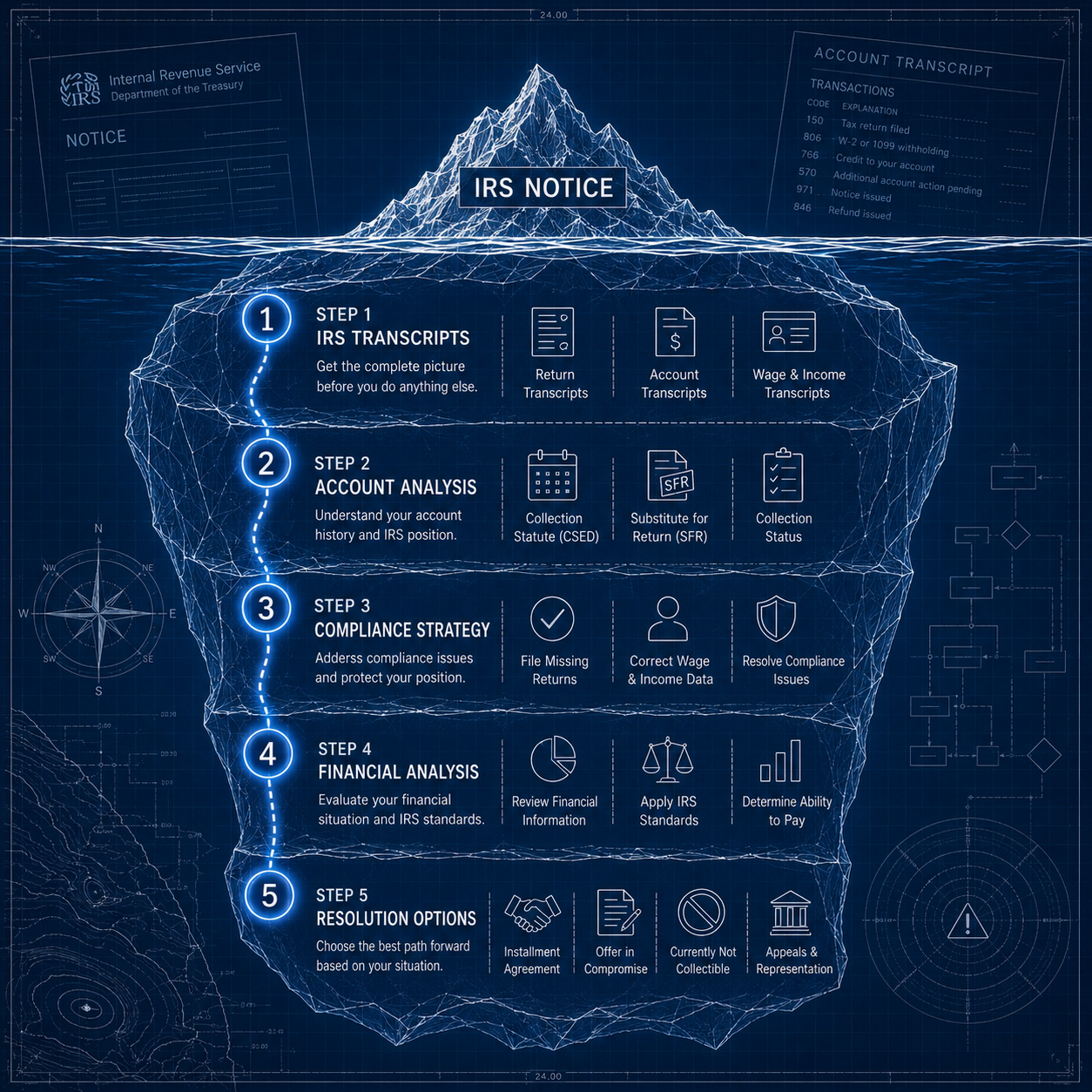
Every IRS case, however complicated it feels right now, comes down to five steps: gather accurate IRS data, analyze the situation strategically, get into compliance in the right order, evaluate your financial reality, and match the right resolution option to your specific facts.
Most mistakes happen when people skip steps or do them out of order. (The IRS is counting on that, frankly.)
Step 1: Pull your IRS transcripts
You can’t make good decisions without knowing what the IRS actually has on file. Your transcripts are the source of truth — not your memory, not old notices, not what your previous preparer thought they remembered about your account.
IRS transcripts show your assessed balances and penalties, your full filing history, current collection status, any Substitute for Returns the IRS has filed on your behalf, and key dates — including one that matters more than most people realize: the Collection Statute Expiration Date.
The CSED is the date the IRS loses its legal right to collect a debt. It’s calculated from assessment dates that only appear in your transcripts. It’s not just a data point. In the right circumstances, it’s a central piece of strategy.
The three transcript types you’ll typically need are the Account Transcript (activity, balances, key dates), the Wage and Income Transcript (W-2s, 1099s, third-party reporting), and the Record of Account (combined return and account data).
CSED — Collection Statute Expiration Date: the date the IRS loses the legal right to collect a tax debt
SFR — Substitute for Return: a return the IRS files on your behalf when you haven't filed one yourself
RCP — Reasonable Collection Potential: the IRS formula for what they think they can realistically collect from you
CNC — Currently Not Collectible: a status that temporarily pauses IRS collection activity
Lien vs. levy — A lien is a legal claim against your property. A levy is actual seizure of assets or wages. One is a warning; the other is not.
Step 2: Analyze what you’re actually dealing with
Transcripts don’t hand you answers. They raise questions and how you answer them shapes everything that follows.
For example: the IRS filed an SFR for a year you didn’t file. Should you file your own return to replace it? Only if your actual numbers produce a better result than what the IRS assessed. Filing without checking first is a common and avoidable mistake.
Your debt is approaching its CSED. A balance with two years left on the collection statute may call for a completely different approach than one with eight years left. In some cases, strategic patience is actually the right move. That’s not something you’re likely to hear from a resolution mill running everyone through the same checklist.
An Offer in Compromise may be on the table. But filing certain unfiled returns first could increase your calculated ability to pay and affect your eligibility. Sequence matters more than most people expect.
Common mistakes include payment plans that drag out IRS collection, actions that give the IRS more time to collect, and rushing into compliance before thinking through the best strategy. Sometimes the order of steps matters a lot.
Step 3: Address compliance — strategically
In IRS terms, compliance usually means having all required returns filed and, when applicable, staying current on estimated tax payments. The exact requirements vary by situation, but in many cases the IRS will not seriously consider a resolution option until the last six years of returns have been filed.
Compliance is required to access most resolution options, but the order and approach matter more than most people realize. Unfiled returns generally need to be addressed. But not always all at once, not always immediately, and not before you understand how each filing affects your overall position.
There’s no virtue in rushing into compliance if doing so makes your resolution options worse. The goal is a compliant position that supports the best possible outcome — not compliance as its own reward.
Step 4: Analyze your financial picture
Once you know what you owe and where you stand on compliance, the focus shifts to what you can realistically afford. More precisely: what the IRS thinks you can afford, which is often a different number than what you’d come up with on your own.
The IRS evaluates your finances using standardized formulas based on Reasonable Collection Potential. They look at national and local expense standards, asset equity at quick-sale value, and disposable income after allowable expenses. The IRS version of your budget and your actual lived experience of your budget are frequently not the same thing. Understanding that difference is where your real options start to come into focus.
That said, the IRS rules are full of nuances. What counts as an allowable expense is not always obvious, and small details can make a big difference in the outcome. Things like housing costs, transportation, childcare, medical expenses, support obligations, and business-related costs may all be treated differently depending on the facts. This is one reason experienced practitioners pay so much attention to the numbers, because the right interpretation can change the whole case.
- Tax is assessed — CSED clock starts here
- Balance due notice issued (CP14) — first formal notification
- Collection notices escalate — CP501 → CP503 → CP504
- Final notice of intent to levy (LT11 or Letter 1058) — this is when your appeal rights are triggered
- Enforcement begins — liens, levies, wage garnishment
- Resolution can step in at any point — earlier generally means more options and more leverage
Step 5: Match the solution to the situation
With a clear picture of your transcripts, compliance status, and financial position, you can actually evaluate your options. Common resolution paths include installment agreements, Offers in Compromise, penalty abatement, Currently Not Collectible status, audit reconsideration, and lien or levy release.
There is no universally correct answer. The right solution depends on your specific facts, your financial picture, and your timing — and those three things interact in ways that aren’t always obvious until you have all the information in front of you.
DIY vs. professional representation
Some situations are genuinely manageable without professional help: small balances, simple filing issues, no active enforcement. If you got a CP14 for $800 and you just need to pay it, you don’t need to hire anyone.
However, with the recent reductions in IRS personnel, even small problems can be difficult to resolve, which may require a professional to contact the IRS on your behalf.
Other situations benefit significantly from having someone who knows the system: large or multi-year balances, SFR involvement, cases approaching the CSED, Offer in Compromise considerations, active levies or garnishments. The difference isn’t just knowing what the options are. It’s understanding what order to do things in and what the consequences are of getting that wrong.
Where an Enrolled Agent fits in
Enrolled Agents are federally licensed by the IRS to represent taxpayers in all matters before the agency — audits, collections, appeals, all of it. It’s the only credential issued directly by the IRS for that purpose.
A note on resolution mills: be cautious of firms that promise specific outcomes before they’ve reviewed your situation, or that seem to have one solution they apply to everyone. Real resolution work is specific, strategic, and sequenced to your facts. If someone tells you what your outcome will be before they’ve pulled your transcripts, that should give you pause. The IRS itself flags OIC mills as a recurring problem — they make the annual Dirty Dozen list of tax scams. Worth a read before you hire anyone.
Start with information, not action
If you’re not sure where to begin, begin with your transcripts. That one step gives you clarity, direction, and a realistic picture of what you’re actually facing. It’s the only foundation a real strategy can be built on — and it’s a lot less scary than sitting with the unknown.
If you want help making sense of what you find, there are two ways to start:
- $99 Transcript Analysis — understand exactly where you stand with the IRS
- $250 Full Intake and Resolution Strategy — a complete written analysis with resolution options and flat-fee pricing for next steps
Learn more about IRS resolution services at Litten Tax.

Enrolled Agent since 2006 with unlimited practice rights before the IRS. Specializing in tax resolution and representation.
Tax resolution services